
Slab leaks
Water Coming Up Through Your Tile Floor in Arlington: Slab Leak or Something Else?
Damp grout, a puddle with no spill, or tile that feels warm? How to tell a slab leak from a dishwasher, toilet or shower leak.
Pool leaks
You are cleaning the pool and spot a thin line in the fiberglass, or a spider web of cracks near the steps. The first question every owner asks is simple: is the pool leaking? Most of the time the answer is no. But some cracks do go all the way through the shell, and North Texas clay soil can make a small problem bigger.
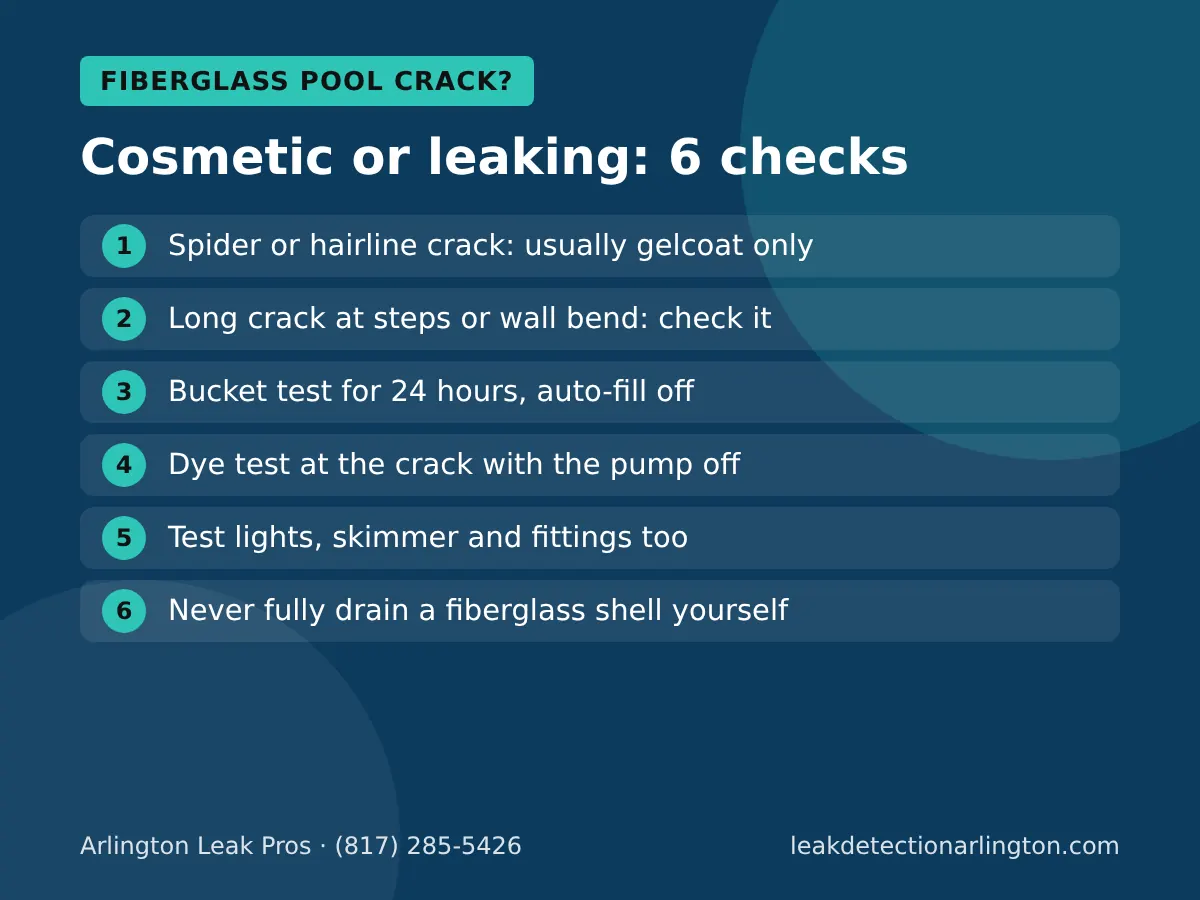
Most cracks in a fiberglass pool are only in the gelcoat, the thin colored surface layer. They look bad but do not leak. A crack is more likely to leak if it is wider than a credit card's edge, runs across a step, bench or wall bend, weeps dye, or comes with a water level that drops more than about a quarter inch a day. A bucket test and a dye test tell you which one you have.
Fiberglass pools are built as one shell in a factory, then set in the ground. The shell has layers: a smooth gelcoat on top, then fiberglass and resin that hold the water. Thousands of Arlington, Mansfield and Grand Prairie backyards have them, many installed in the 2000s and 2010s. As those pools age, cracks are one of the top reasons owners call us.
A gelcoat crack is a hairline crack in the surface finish only. It often looks like a spider web or a star and does not go through the shell, so it rarely leaks. A structural crack goes through the fiberglass layers. It is usually a single longer line, may feel raised or sharp, and often shows up at stress points such as steps, benches, corners or the floor-to-wall bend.
| Clue | Likely gelcoat (cosmetic) | Possibly structural (can leak) |
|---|---|---|
| Shape | Spider web, star, tiny hairlines | One long line or a clean split |
| Width | Thinner than a hair | You can catch a fingernail in it |
| Location | Anywhere, often in sunny spots | Steps, benches, corners, wall bends, near fittings |
| Feel | Smooth surface | Raised edges, soft or flexing area |
| Water level | Normal evaporation only | Drops faster than a bucket of water beside it |
| Dye test | Dye drifts past | Dye is pulled into the crack |
Think you have a leak? A licensed Arlington technician answers 24/7.
Call Now (817) 285-5426North Texas clay soil is the main reason. It swells after heavy rain and shrinks during drought, so the ground around a pool shell pushes and pulls through the year. Other causes include poor backfill when the pool was set, draining the pool too low, hard impacts, and gelcoat that has aged in strong Texas sun and harsh pool chemistry.
Start with a bucket test to confirm the pool is losing more water than evaporation. Then do a dye test right at the crack with the pump off and the water still. If dye is drawn into the crack, it is leaking. If the dye drifts away, the crack is probably not the source, and the leak may be in the plumbing, a light or a fitting.
A water level that falls with the pump on but not off points to the pressure-side plumbing instead. Lights are another common culprit. Our post on pool leak detection arlington tx shows how a light niche leak looks.
Call for help if a crack weeps dye, keeps getting longer, sits on a step or wall bend, or comes with a bulging or soft area in the shell. Also call if the pool loses more than about a quarter inch a day and you cannot find the source. A pro confirms the leak, checks the plumbing and lights, and tells you whether the crack is structural.
Warning signs that need fast attention:
Our pool leak detection in Arlington visits use dye testing, pressure tests on each line and underwater listening gear. You get the leak points marked, photos and a written report you can hand to a fiberglass repair company or your insurer.
Cosmetic gelcoat cracks are ground out and filled with matching gelcoat, often without draining. Structural cracks are ground down, rebuilt with new fiberglass mat and resin from the back side or front, then gelcoated. That usually means partly draining the pool on a cool, dry day. Leak detection in Arlington runs about $250 to $550, and repairs are priced after the crack is confirmed.
| Step | What happens | Approx. time |
|---|---|---|
| Pool leak detection | Bucket, dye and pressure tests, report | 2 to 4 hours |
| Gelcoat crack repair | Grind, fill, sand and polish | Half a day to 1 day |
| Structural crack repair | Partial drain, fiberglass layers, gelcoat | 1 to 3 days plus cure time |
| Full resurface | New gelcoat over the whole shell | 1 to 2 weeks |
Never drain a fiberglass pool all the way on your own. With wet clay around it, an empty shell can bulge or pop up. Ask the repair company to check groundwater first.
Yes. In most fiberglass pools we test, the leak turns out to be at a light, a skimmer, a return fitting or the underground plumbing, not the crack that caught the owner's eye. That is why a full test of the shell and every line matters before anyone grinds into the fiberglass.
If the meter at the street keeps turning even with the pool's auto-fill shut off, the leak may be in your house lines. The guide on water leak detection arlington explains how to read the bill and meter for those clues.
Call (817) 285-5426 any time. We test pools across Arlington ZIPs 76001 to 76018, plus Pantego, Dalworthington Gardens, Kennedale, Mansfield and nearby Grand Prairie.
Most do not. Hairline and spider cracks are usually only in the gelcoat surface. A crack can leak if it goes through the fiberglass, which is more common at steps, benches, corners and wall bends. A dye test at the crack with the pump off shows whether water is being pulled in.
Do a bucket test for 24 hours with the auto-fill off. If the pool drops more than the water in the bucket on the step, it is leaking. Then dye test cracks, lights, skimmers and fittings with the pump off to narrow down the spot.
Do not drain it fully yourself. Fiberglass shells rely on the water inside to balance soil pressure, and Arlington's wet clay can push the walls in or lift the shell. A repair company drains only as much as needed after checking groundwater.
Expansive clay soil swells after rain and shrinks in drought, which stresses the shell. Poor backfill under steps, a low water level, old brittle gelcoat and impacts also cause cracks.
Pool leak detection in Arlington usually costs about $250 to $550 for most home pools. The price depends on the pool size and how many lines need testing, and it is confirmed before work starts.
Slab leaks
Damp grout, a puddle with no spill, or tile that feels warm? How to tell a slab leak from a dishwasher, toilet or shower leak.
Pool leaks
Autofill always running or the water bill climbing? How to tell a stuck valve from a real pool leak with a simple shutoff test.
Pool leaks
Wet pad or deck under your spa? How to open the cabinet safely and check the pump seal, heater unions, valves, jets and drain plug.
Arlington Leak Pros finds hidden slab, water line, pool and wall leaks without tearing up your home. Open 24/7.
(817) 285-5426