
Insurance
Leak Detection Report for an Insurance Claim: What Arlington Homeowners Need
What a leak detection report should show, the photos adjusters want, and how it helps a Texas water claim.
Slab leaks
Your water bill jumped, a spot on the floor feels warm, or you can hear water running when every tap is off. You are pretty sure it is a slab leak. Now you have to decide who to call: a general plumber, or a company that only finds leaks. The order you call them in can decide how much of your floor gets broken up.
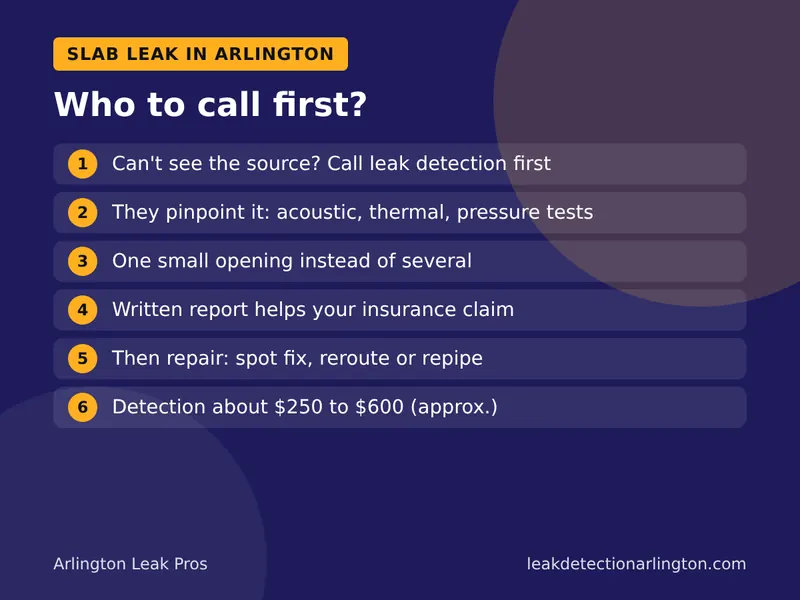
Call a leak detection company first when you cannot see where the water is coming from. A slab leak is under concrete, so the first job is finding the exact spot, not digging. A specialist pinpoints it with acoustic, thermal and pressure tests, then a plumber repairs it with one small opening instead of several. Call (817) 285-5426 to book a slab leak test.
Our slab leak detection in Arlington visits usually find the leak within a few feet, so the repair crew knows exactly where to open the floor.
A leak detection company finds leaks. It uses listening gear, thermal cameras, pressure tests and line tracers to locate a break without opening walls or floors. A plumber repairs pipes. Many plumbers fix slab leaks well, but not all carry detection tools or have a tech trained to use them, so some find the leak by trial and error.
| Task | Leak detection company | General plumber |
|---|---|---|
| Confirm there is a leak (meter and pressure test) | Yes | Usually |
| Find the exact spot under the slab | Yes, with acoustic and thermal tools | Some, depends on equipment |
| Tell hot line from cold line | Yes | Sometimes |
| Written report with photos for insurance | Yes | Rarely |
| Break the slab and repair the pipe | Some do | Yes |
| Reroute or repipe | Some do | Yes |
We do both. Our technicians locate the leak and our crew can handle slab leak repair in Arlington TX the same week, so you are not passing your problem between two companies.
Because guessing is expensive. If a plumber opens the floor where the warm spot is, the leak may be several feet away, since water travels along the pipe and under the slab before it shows. Each extra opening means more concrete, more flooring and more time. Pinpointing first usually means one hole, about two feet square, right over the break.
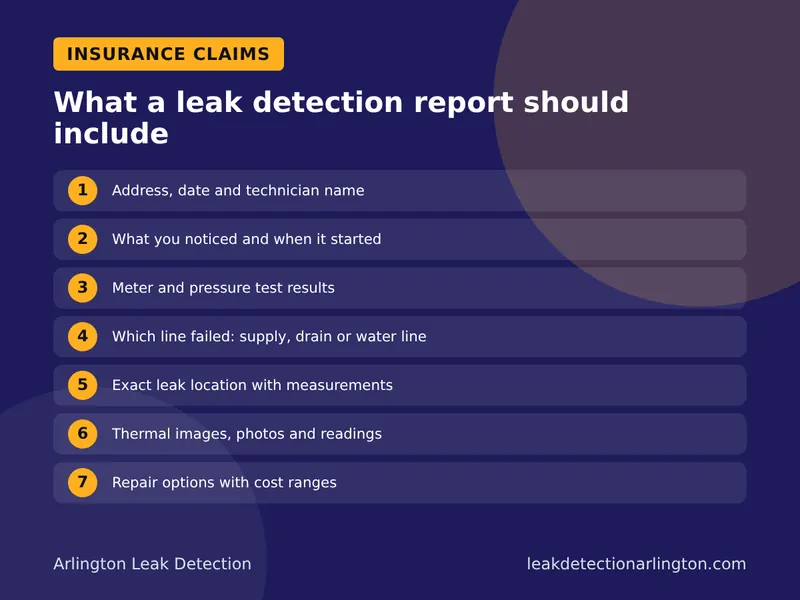
It also matters for insurance. Many Texas policies pay for the tear-out and the floor repair after a sudden slab leak, but they want proof of what failed and where. A detection report gives your adjuster that proof. Our guide on leak detection reports for insurance explains what to ask for.
The common signs are a water bill that jumped with no change in use, a warm or damp spot on the floor, the sound of running water with every tap off, a meter that keeps moving, low water pressure, and cracks or mildew smell near baseboards. Two or more of these together make a slab leak likely.
Our full list of slab leak signs in Arlington homes shows photos of each one.
Use the water meter. Turn off every faucet, the ice maker, irrigation and the washer. Note the meter reading or watch the small leak indicator. Wait 30 to 60 minutes without using water. If the reading moved, water is leaving the system somewhere. Then shut the valve on the water heater's cold inlet and test again to see if the leak is on the hot side.
If the meter still moves and you cannot find a running toilet or dripping hose bib, the leak may be in the yard line instead of under the slab. Our guide to waterline leak detection arlington homeowners use explains how to tell the two apart.
The technician confirms the leak with a pressure test, isolates the hot and cold sides, then traces the lines under the slab. They listen with ground microphones, scan with a thermal camera for warm water lines, and mark the spot on the floor. Most visits take about one to three hours, and you get a written report with photos.
Want a step-by-step look before you book? Read our walkthrough of a leak detection arlington slab visit, from the first meter check to the final mark on the floor.
Slab leak detection in Arlington usually costs about $250 to $600. Basic leak detection runs about $150 to $400. A spot repair through the slab usually costs about $1,500 to $4,000, including breaking and patching the concrete. Rerouting or repiping is priced separately, depending on how many lines and rooms are involved.
| Service | Approx. cost |
|---|---|
| Basic leak detection | $150 – $400 |
| Slab leak detection | $250 – $600 |
| Water line leak detection | $200 – $500 |
| Slab leak spot repair | $1,500 – $4,000 |
If your home has had more than one slab leak, a reroute or a whole-home repipe may be the smarter fix. To get a rough number for that, try this house repiping cost calculator, then compare it with a spot repair. Our guide to reroute vs spot repair walks through the trade-offs.
Ask how the leak was located, how close the mark is, whether it is a hot or cold line, and how big the opening will be. Ask who repairs the floor covering afterward and whether a reroute would avoid breaking the slab. A good company answers all of these in plain words before the jackhammer comes out.
Arlington sits on expansive clay soil. It swells after heavy spring rain and shrinks in long summer droughts, and that movement shifts slab foundations and bends the pipes inside them. Many homes built from the 1970s through the 1990s also have copper or older lines under the slab that are now 30 to 50 years old.
We see slab leaks all over town, from older neighborhoods near UT Arlington and Randol Mill Road to newer subdivisions in South Arlington, Viridian and the Southwest Arlington ZIP codes 76001, 76016 and 76017. If you live anywhere in Arlington, our leak detection Arlington TX team can usually be there the same day.
Call a leak detection company first if you cannot see where the water is coming from. They pinpoint the leak under the slab without digging, so the repair only needs one small opening. Many leak detection companies, including ours, also do the repair.
Some can. Finding a leak under concrete takes acoustic listening gear, thermal cameras and pressure testing. Plumbers who do not carry that equipment may have to open the floor in more than one place to find the break.
Slab leak detection in Arlington usually costs about $250 to $600. Basic leak detection runs about $150 to $400. You get the price before the test starts.
A spot repair through the slab usually costs about $1,500 to $4,000, including breaking and patching the concrete. Rerouting or repiping is priced by the job.
A slab leak on a hot water line or one that is flooding floors should be treated as urgent. Shut off the main valve or the water heater supply and call right away. A slow leak still needs a test soon, because water under a slab can damage flooring and the foundation over time.
Insurance
What a leak detection report should show, the photos adjusters want, and how it helps a Texas water claim.
Slab Leaks
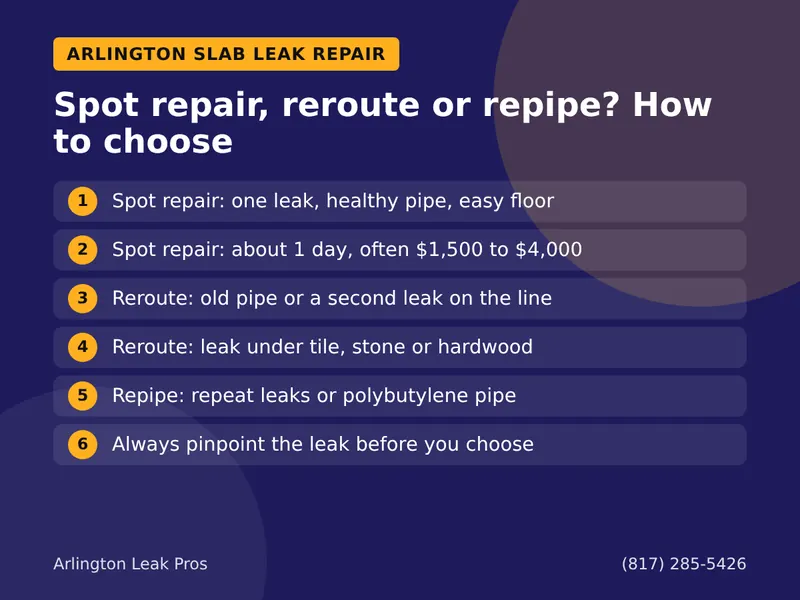
Spot repair, reroute or repipe? How each slab leak fix works, what it costs and when it makes sense.
Hidden Leaks
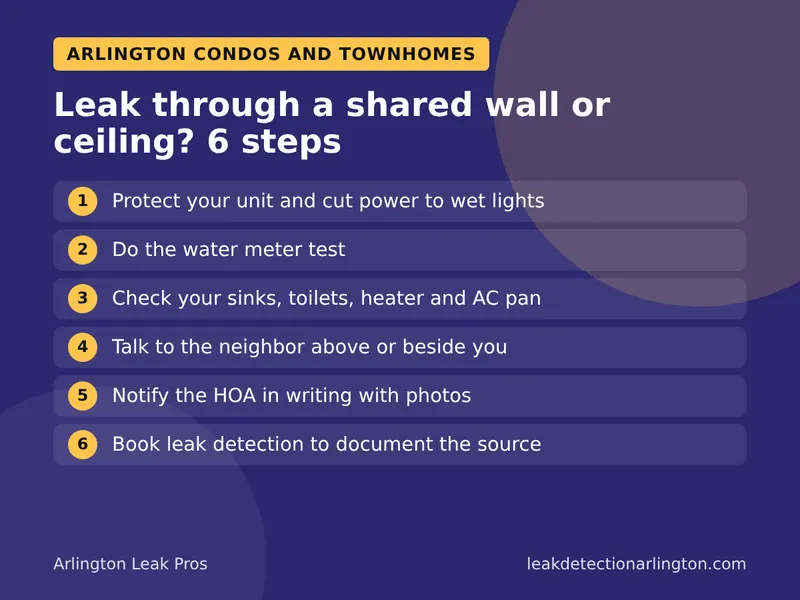
Water through a shared wall or ceiling? How to find which unit it comes from and who is usually responsible.
Arlington Leak Pros finds hidden slab, water line, pool and wall leaks without tearing up your home. Open 24/7.
(817) 285-5426