
Pool leaks
Pool Leak Repair in Arlington, TX: What Happens After the Leak Is Found
The leak is marked. Now what? How skimmer, light niche, crack and underground plumbing leaks get fixed in Arlington pools.
Pool leaks
Many Arlington backyards have a spa built into the pool, with a spillover edge that pours into the pool. When the spa level drops, it is hard to tell if water is leaking out of the system or just moving into the pool. The answer changes who you call and what gets fixed. Here is how to tell the difference and what to check first.
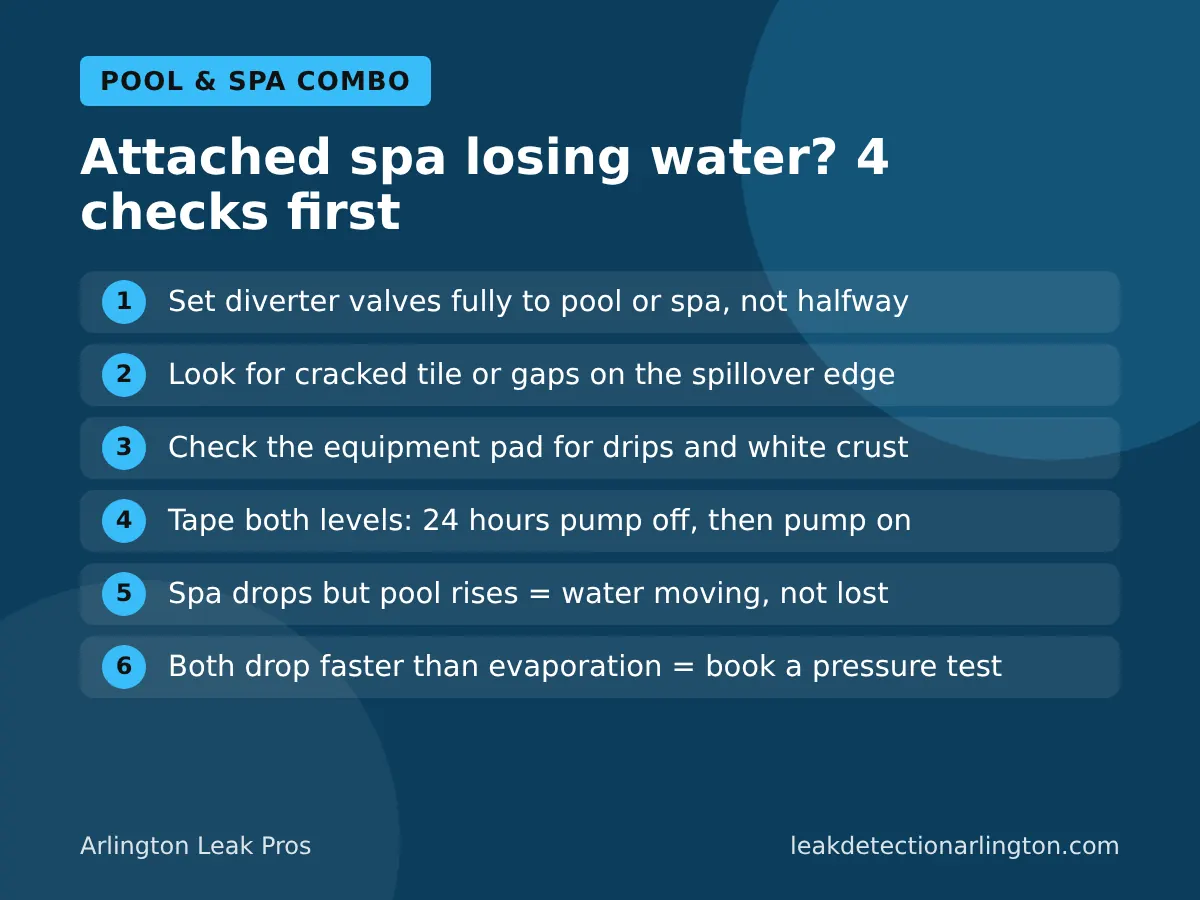
If an attached spa loses water but the pool level stays the same or rises, the water is usually moving into the pool, not leaving the system. That points to a valve, spillover gap or shared line problem. If both the spa and pool drop together faster than evaporation, the system has a real leak, often in the shell, fittings or underground plumbing.
Pool and spa combos are common in Arlington, from newer builds in Viridian and Southwest Arlington to older pools near Lake Arlington and in Dalworthington Gardens. They share one pump, one filter and one set of underground pipes. That design saves space, but it also means one small problem can show up in a confusing way.
If you have a stand-alone hot tub on a patio instead, the checks are simpler, because there is no pool for the water to move into. Any steady drop beyond evaporation is a leak in the tub, its pump, heater or plumbing.
An attached spa sits higher than the pool. When the pump runs in spa mode, valves send water to the spa jets and it spills back over the edge or returns through its own lines. When the pump stops, the spa should hold its level. If a valve, check valve or spillover gap lets water drain back, the spa slowly empties into the pool.
Most combos have three key parts:
When the spa drains into the pool, you lose no water overall. The pool may even creep up a little. When the spa drops and the pool drops too, water is leaving the system somewhere.
Mark both water levels with tape and check them after 24 hours with the pump off. If the spa drops while the pool rises or stays even, water is transferring. If both drop more than about a quarter inch a day in cool weather, you have a leak. Repeat the test with the pump running to see if the loss happens under pressure.
| What you see after 24 hours | What it usually means |
|---|---|
| Spa drops, pool rises or stays even | Water is moving from spa to pool through a valve or the spillover |
| Spa and pool both drop, pump off | Leak in the shell, a fitting, light niche or suction-side plumbing |
| Both drop only when the pump runs | Leak in pressure-side plumbing, often under the deck |
| Spa drops only in spa mode | Leak in spa return lines or at spa jets |
| Levels steady, but deck or yard stays wet | Possible leak at the equipment pad or a nearby supply line |
Arlington summers can evaporate a quarter inch or more a day, so run the test on a mild day if you can. A bucket test on the pool step helps you compare against normal evaporation.
Check the diverter valve positions, look along the spillover edge for cracks or gaps, inspect the equipment pad for drips, and run the 24-hour tape test with the pump off and then on. These four checks take about two days and often tell you whether you need a valve adjustment or a full leak test.
If you see wet soil or a soft spot between the pad and the pool, the problem may be in the buried lines. That kind of loss works a lot like a home supply line leak, and our post on waterline leak detection Arlington explains how buried leaks get traced.
The most common spots are the spa's jets and returns, the spillover tile line, the light niche in the spa, diverter and check valves at the pad, and the shared underground return and suction lines. Arlington's clay soil swells when wet and shrinks in drought, which can stress buried pipe joints and the bond beam under the spillover.
A leak technician tests the spa and pool as separate systems. They plug lines one at a time and pressure test each one, use dye at jets, fittings and the spillover, and listen to buried pipes with acoustic gear. Testing each line on its own is the only reliable way to tell a valve transfer from a true leak in a combo.
A typical visit goes like this. The tech checks your tape test notes, inspects the pad, and dives or wades to dye-test the spa shell and fittings. Then they isolate each line at the pad and pressure test it. If a line won't hold pressure, they trace it under the deck to mark the spot.
Pool and spa testing runs about $250 to $550 in Arlington. Our page on pool leak detection Arlington TX cost explains what changes the price. A spa-only check on a simple system is often at the lower end.
If you also see signs inside the house, like a higher water bill with the pool on auto-fill turned off, it may be a separate home plumbing leak. That is a different test. Our guide to a leak detection Arlington visit for slab leaks covers what happens then.
If water is only moving from the spa to the pool, it is usually safe to keep using it while you schedule service. If the system is losing water, keep the level above the skimmer and spa intakes so the pump does not run dry. Turn off auto-fill during testing, or you will hide the leak and raise your water bill.
A pump that runs dry can overheat and damage its seal within minutes. If the spa level falls below its intakes while in spa mode, switch to pool mode until it is checked.
Need a spa or combo tested? Our team handles hot tub leak detection in Arlington for in-ground spas, pool and spa combos and stand-alone tubs. Call (817) 285-5426 24/7. We cover Arlington ZIP codes 76001 to 76018, plus Pantego, Dalworthington Gardens and nearby Grand Prairie.
Usually a diverter valve or check valve is not sealing, or there is a gap at the spillover edge. Water runs downhill from the higher spa into the pool. The total water in the system stays about the same, so it is a transfer problem rather than a true leak.
In cool weather, about a quarter inch a day or less is common from evaporation. In an Arlington summer with wind and heat, it can be more. A bucket test on the pool step shows your normal evaporation for that week.
Yes. A crack in the spillover tile or the bond beam under it can let water seep out of the shell or between the spa and pool. Soil movement in Arlington's clay can open these cracks over time.
Usually not. Most leak tests use dye, pressure tests on each line and acoustic listening with the water in place. Draining is rarely needed just to find a leak.
Pool and spa leak detection usually runs about $250 to $550 in Arlington. A simple spa-only test is often at the lower end. Repairs are priced separately once the leak is found.
Pool leaks
The leak is marked. Now what? How skimmer, light niche, crack and underground plumbing leaks get fixed in Arlington pools.
Freeze leaks
Pipes froze overnight? Where cracked lines hide after the thaw in Arlington homes, from hose bibs to attics, slabs and yard lines.
Slab leaks
Leak under the kitchen tile or a finished closet? How tunneling under an Arlington slab compares with breaking the floor, and when each one makes sense.
Arlington Leak Pros finds hidden slab, water line, pool and wall leaks without tearing up your home. Open 24/7.
(817) 285-5426