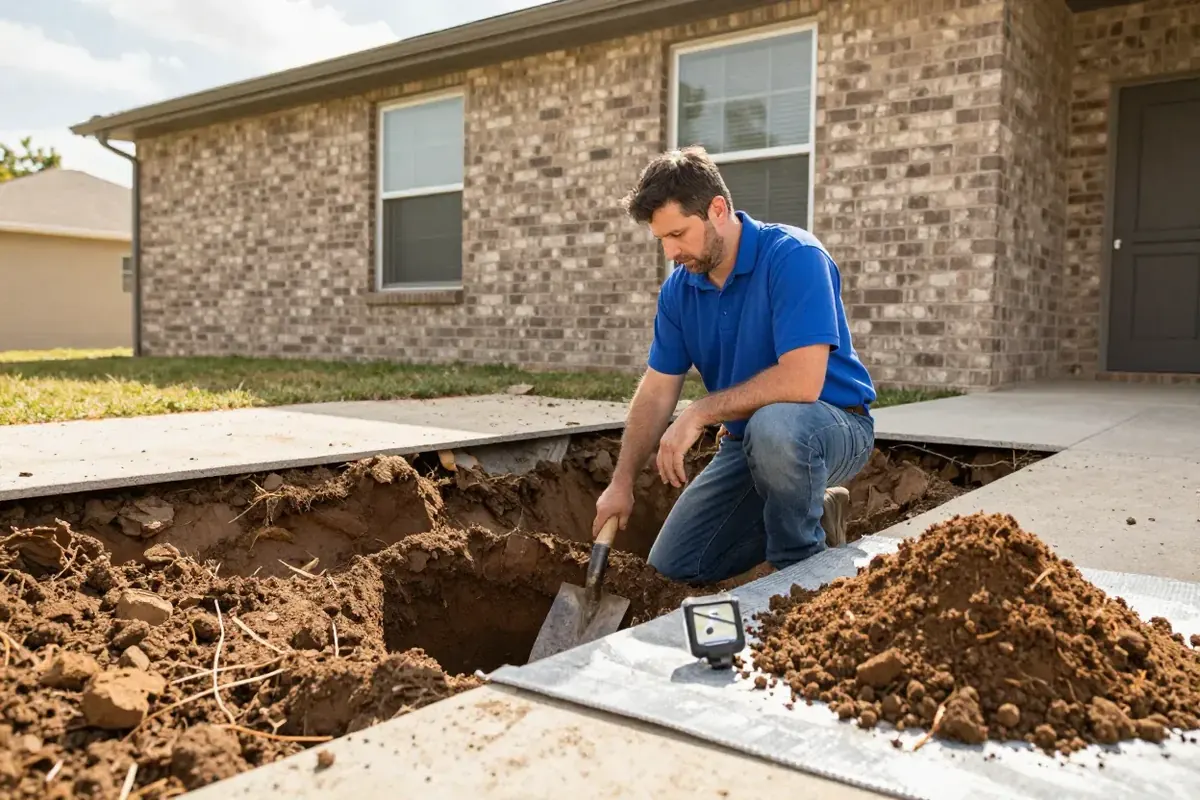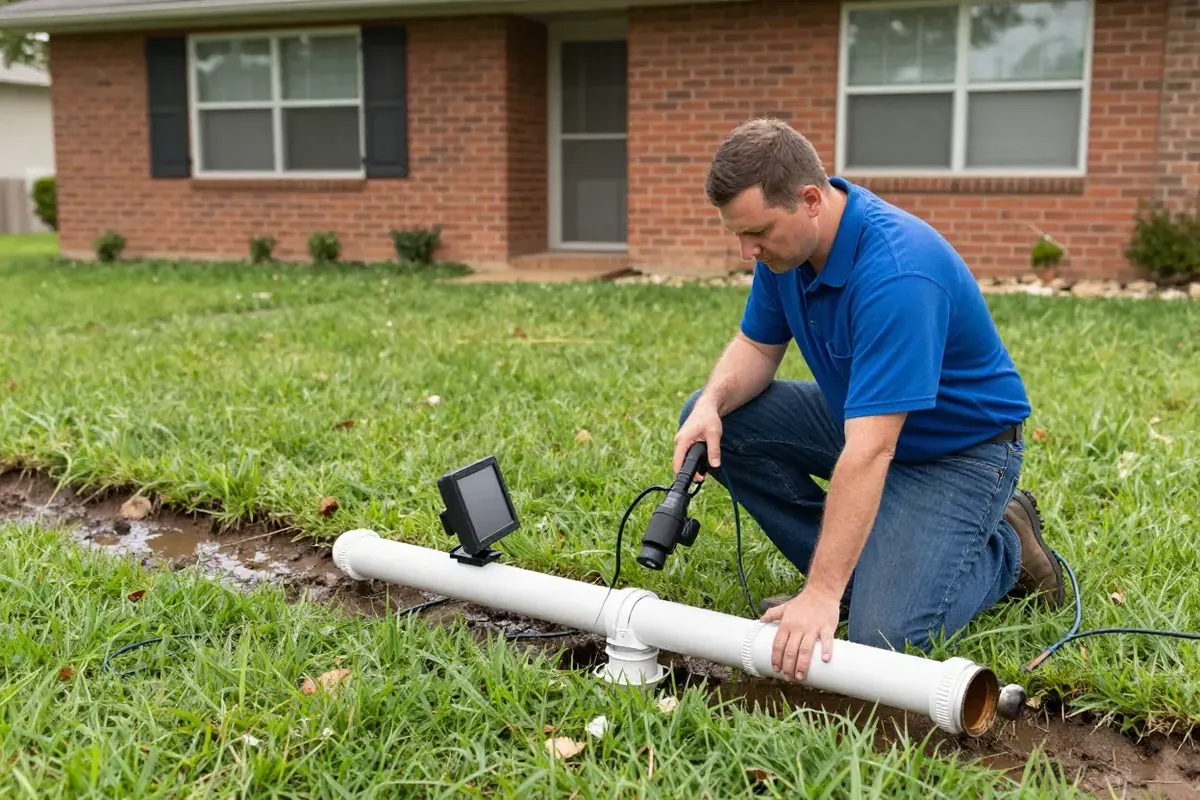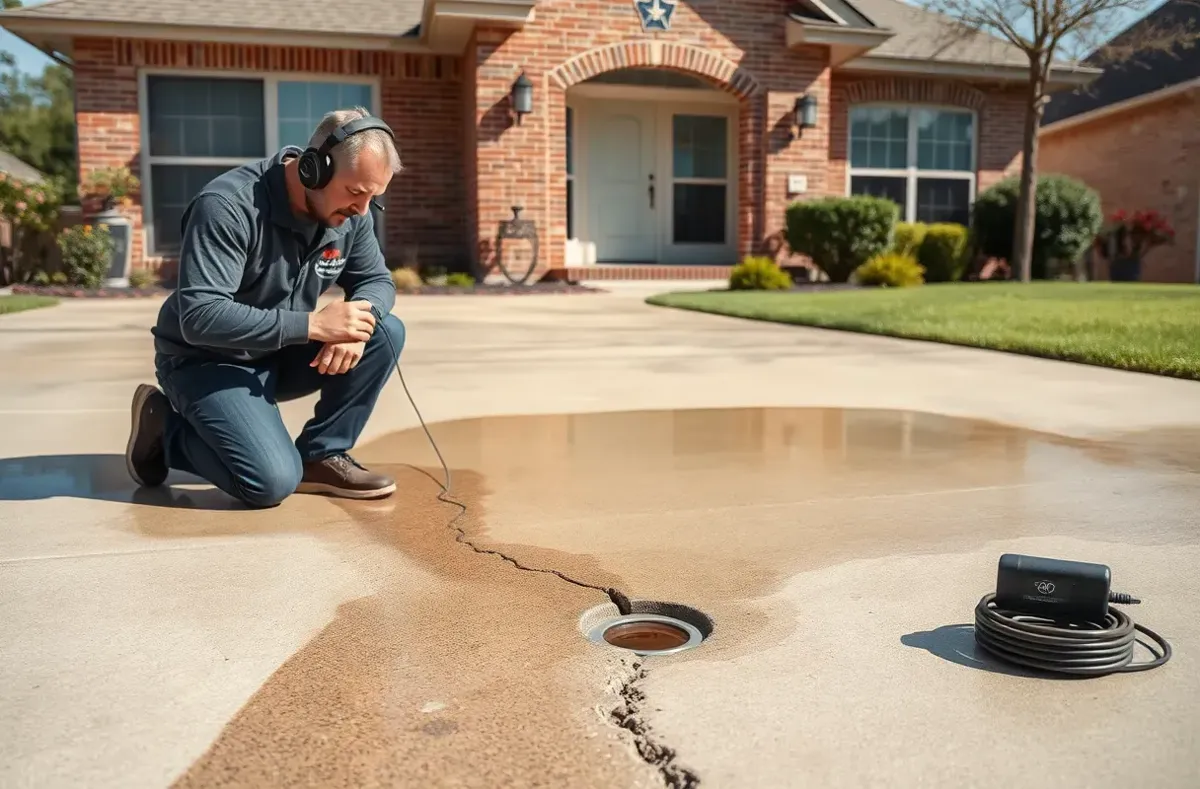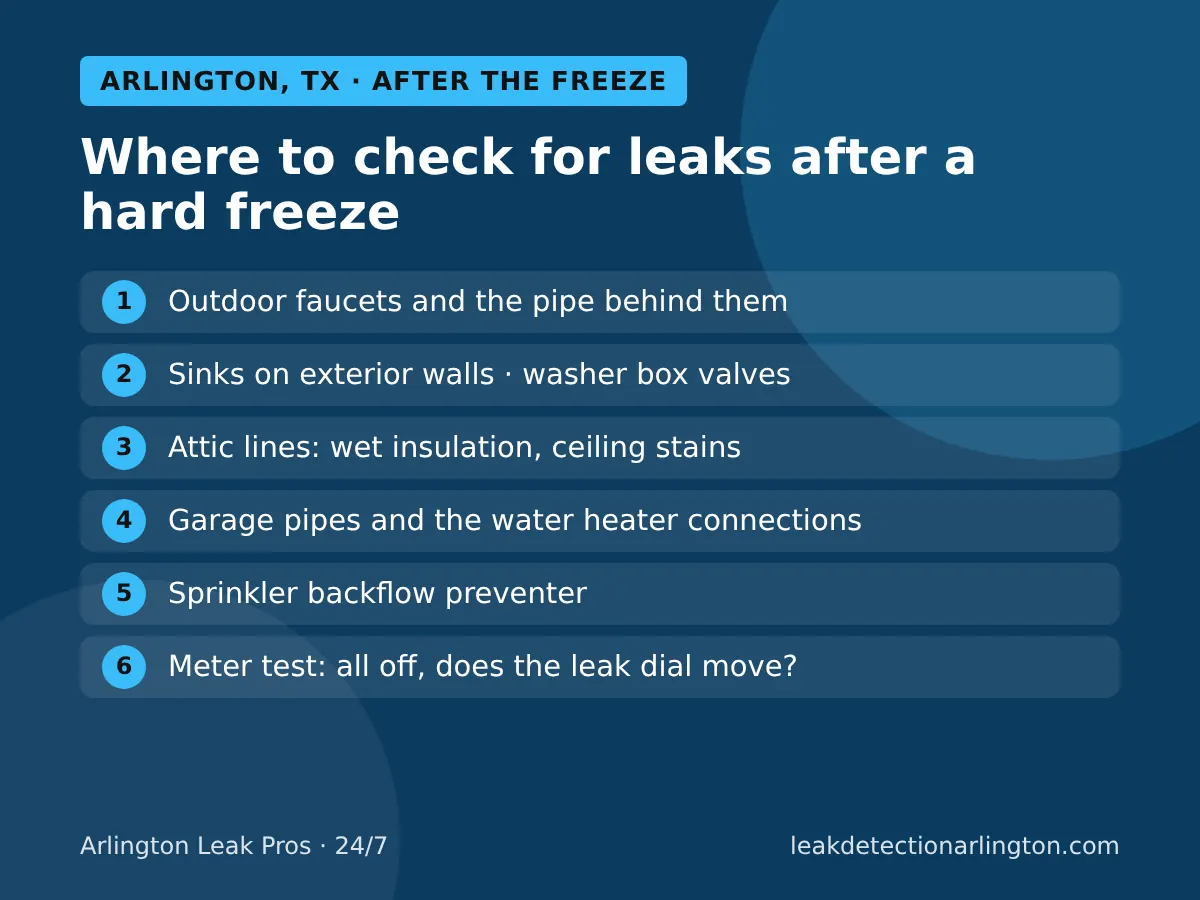
After a hard freeze, check the places where pipes are coldest first: outdoor faucets, pipes in exterior walls, the attic, the garage, the water heater closet and the line from the meter to the house. Then do a meter test with every fixture off. If the meter still moves, you have a leak, even if you cannot see water.
Many Arlington homeowners remember February 2021, when days below freezing split pipes across Tarrant County. Smaller freezes do the same thing to one or two pipes at a time. If your meter says you have a leak but you cannot find it, our leak detection services team can pinpoint it without tearing into walls.
Why do leaks show up after the freeze and not during it?
Water expands about nine percent when it freezes. That pressure splits copper, PEX fittings and old galvanized pipe, but the ice plugs the crack while it stays frozen. When the pipe thaws and water pressure returns, the crack starts leaking. That is why many freeze leaks appear hours or even a day after temperatures climb above freezing.
The split is often not where the ice formed. Pressure builds between the ice plug and a closed faucet, so the pipe can burst a few feet away, inside a wall or the attic. Watch closely for the first 48 hours after a freeze.
Where should you check first for freeze damage?
Start outside and in unheated spaces, then work inward. The eight most common freeze leak spots in Arlington homes are hose bibs, exterior wall pipes behind sinks, attic lines, garage pipes, the water heater closet or garage heater, washer boxes on outside walls, irrigation backflow preventers and the yard line from the meter to the house.
- Outdoor faucets (hose bibs). Turn each one on. If water sprays inside the wall or nothing comes out, the pipe behind it may be split. Frost-free hose bibs crack inside the wall when a hose was left on.
- Sinks on exterior walls. Open the cabinet under the kitchen and bathroom sinks. Feel for wet wood and look at the back wall.
- Attic pipes. Many two-story and older homes run water lines through the attic. Look for wet insulation and ceiling stains below.
- Garage. Check the pipes going to the water heater, softener and any utility sink.
- Water heater. Look at the cold inlet, the hot outlet and the relief valve line.
- Washer box. Laundry valves on outside walls freeze often. Check for drips behind the washer.
- Backflow preventer. The brass device on your sprinkler system cracks easily. Look for spraying water when the system runs.
- Meter box and yard line. Soggy spots or water flowing along the curb point to the main line.
How do you test for a hidden leak after a freeze?
Use your water meter. Turn off every faucet, the ice maker, the washer and the sprinklers. Look at the meter's small leak indicator, usually a red or blue triangle or dial. If it moves at all over 15 minutes, water is flowing somewhere. Then close the house shutoff valve. If the meter still moves, the leak is in the yard line.
| What you see | Likely leak location |
|---|
| Meter moves, house valve closed | Yard line between the meter and the house |
| Meter stops when house valve is closed | Inside the house: walls, attic or slab |
| Warm spot on the floor, hot water bill up | Hot water line under the slab |
| Sound of running water with everything off | Pipe in a wall, ceiling or slab |
| Sprinkler zone has low pressure or a geyser | Backflow preventer or irrigation line |
If you find the yard line is leaking, our guide on waterline leak detection Arlington explains how buried line leaks are found and fixed without digging up the whole yard.
What should you do if a frozen pipe has burst?
Close the main shutoff valve right away, turn off the water heater, and open a faucet at the lowest point of the house to drain the lines. Turn off power to any wet area. Then move belongings, mop up and take photos. Call a plumber to repair the split and a water damage crew if drywall, carpet or cabinets got wet.
Know where your main valve is before the next freeze. In Arlington it is usually near the front foundation, in the garage, or in the meter box at the curb, which needs a meter key. A burst pipe can release several gallons a minute, so seconds count.
Can a freeze cause a slab leak?
Rarely directly, because pipes under the slab are insulated by the ground. But a hard freeze can split the pipe where it rises out of the slab in an exterior wall or garage, and the water can run down into the slab and under flooring. Thaw cycles also move expansive Arlington clay, which can stress pipes already weakened by age.
If you notice warm spots, damp baseboards or a hot water heater that runs nonstop after a freeze, ask for slab leak detection. A professional uses acoustic listening, thermal imaging and pressure tests to find the exact spot.
What about pools and outdoor plumbing?
Pool equipment freezes faster than house pipes because it sits above ground. Pumps, filters, heaters and the pipes between them can crack if the pump was off during the freeze. After a thaw, look for water around the equipment pad and watch whether the water level drops more than about a quarter inch a day.
A cracked return line or skimmer can leak underground where you cannot see it. Our page on pool leak detection cost in Arlington explains what testing involves and what it usually costs.
How much does leak detection cost after a freeze in Arlington?
A basic leak detection visit in Arlington usually costs about $150 to $400. Finding a leak on a buried water line runs about $200 to $500, and slab leak detection about $250 to $600, usually with a written report. Repairs are priced separately once the exact spot is known, so you only open the wall, floor or yard where needed.
After a widespread freeze, plumbers and leak detection crews book up fast. Call early, keep the water off if you can, and save photos and your water bill for insurance. Call (817) 285-5426 24/7 to get help in Arlington, from the Viridian area and Lake Arlington to South Arlington and the neighborhoods near UT Arlington.